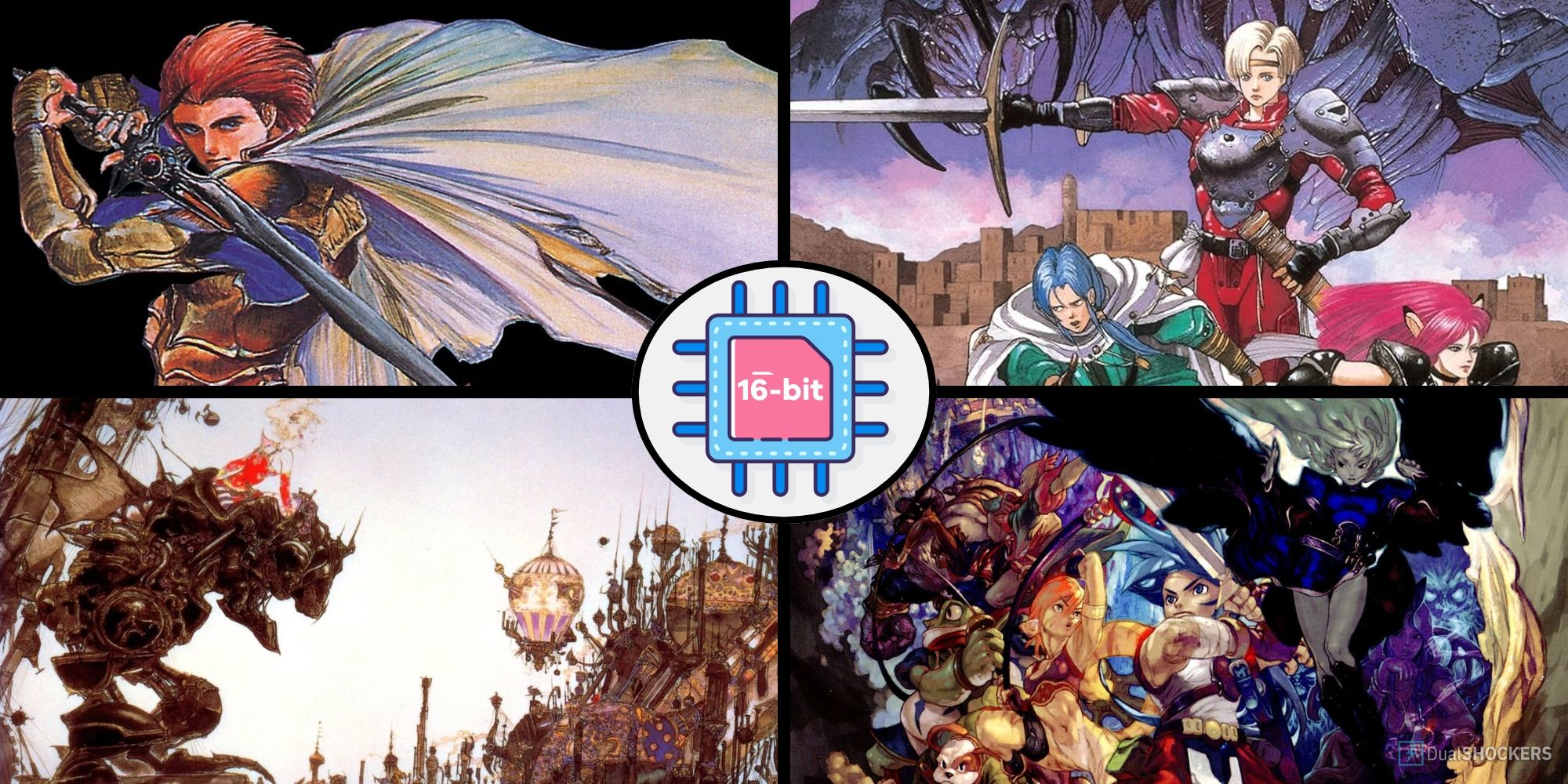
In the fourth console generation, we started getting 16-bit games, released on globally renowned systems like the Super Nintendo and the Sega Genesis, known as the Mega Drive worldwide.
There were some lesser-known consoles, such as the PC Engine, Neo Geo, and even the CD-i, but their game catalogs were nowhere near as popular as their more famous peers.
Related
9 Best JRPGs With Social Links
These games are the closest to social interaction a JRPG fan will ever get.
Many legendary series were born on these 16-bit consoles, while others continued to showcase the evolution of established franchises.
In particular, JRPGs were one of the most beloved genres of the fourth generation. In this list, I’ll highlight the best 16-bit JRPGs, ones you can play today and still enjoy without a nostalgia lens.
Plenty of phenomenal 16-bit JRPGs never left Japan until future ports or remasters. Thus, this list will only include games with international releases.
10 Breath of Fire II
The Dragon Clan Lives

Breath of Fire II

- Released
- December 10, 1995
- Publisher
- Capcom, Laguna, Ubisoft
- Engine
- bof engine
- ESRB
- t
- How Long To Beat
- 34 Hours
Here’s a quick fact about me: Breath of Fire III is my favorite game ever. That said, I still have a fair and critical eye toward the other entries in the series.
That’s why I included Breath of Fire II here instead of the first title, which, despite kicking off the franchise, is a rather weak JRPG compared to other 16-bit games.
The second game, however, improves on everything introduced in the original. Battles are better, the characters are more charismatic, the story has more depth, and the progression system is more unique thanks to its fusion feature.
9 Pier Solar and the Great Architects
A Sega Genesis Game Released in 2010

Pier Solar and the Great Architects
- Released
- September 29, 2014
- ESRB
- Teen // Violence, Blood, Mild Language, Crude Humor, Use of Alcohol and Tobacco
This is a really odd entry. Not because the JRPG is bad, but because it’s a Sega Genesis game released in 2010. Yup, you read that right.
Pier Solar and the Great Architectsstarted as a dedicated Sega homebrew community project and eventually became a full-fledged game for the Genesis.
To be brutally honest, the game isn’t that great in its original Sega Genesis/Mega Drive version, but its enhanced edition, available on PC and PS4, is more than enough to scratch that nostalgia itch.
It’s your typical turn-based JRPG, where protagonist Hoston and his two friends set out to find a cure for his father’s mysterious illness. It doesn’t take long for the plot to get increasingly ambitious.
If Pier Solar piques your interest, adjust your expectations. Its most significant feat is being a dedicated 16-bit game released in 2010 instead of a modern title merely mimicking that era’s graphics.
8 Phantasy Star IV
One of the Few Sci-Fi JRPGs of the Time

Phantasy Star IV is arguably the magnum opus of turn-based JRPGs on the Mega Drive. Not that the competition was fierce, as Sega’s 16-bit console didn’t have many of them, but that still meant something.
Phantasy Star stood out as one of the few sci-fi JRPG series of its time. With each new entry, the games improved exponentially, especially regarding their anime cutscene-style storytelling.

Related
8 JRPGs Better Than They Have Any Right To Be
Never judge a book by its cover or a JRPG by its excessively anime protagonist.
Turn-based battles also got a glow-up. While the first three games didn’t show characters during fights, Phantasy Star IV finally did, allowing us to see them in action, making battles more immersive.
Unfortunately, like many games of its era, the JRPG suffers from glaring translation issues. Still, nothing that a present-day port couldn’t fix while adding a few modern quality-of-life improvements.
7 Secret of Mana
The Best The West Got

While Trials of Mana is a vastly superior sequel to Secret of Mana, the original version was never released in the West. Hence, the second Mana game is highlighted here.
That’s not to say Secret of Mana is bad. Quite the opposite, it’s one of the finest action RPGs of the 16-bit era. It made us think strategically about when to strike, when to retreat, and which spell to cast.
As we progress in our mission to empower the Sword of Mana and save the world from an evil empire, we unlock new weapons and level them up, translating into more available special attacks.
Best of all, Secret of Mana allowed up to three players to play together simultaneously if you had an SNES multitap, making the adventure even more fantastic. Not that anyone had a multitap in the 90s, right?
6 Shining Force II
The Best 16-Bit Tactical JRPG

Shining Force 2
- Released
- October 19, 1994
- Developer
- Sonic! Software Planning
- ESRB
- E // Mild Fantasy Violence
Shining Force II was a tactical JRPG ahead of its time. While many modern tactical RPGs forgo exploration entirely in favor of point-based traversal, Shining Force II lets players freely explore towns and even an overworld map.
There were some teething issues regarding the world map, such as random battles. Still, this exploration allowed us to interact with NPCs, discover optional characters, and find hidden treasures, just like in a more traditional RPG.
While Shining Force II’s main story wasn’t groundbreaking, the battle system and character progression were rewarding and avoided falling into the repetitive gameplay loop that plagues many tactical RPGs.
Since the West didn’t get Fire Emblem back then, we had to make do with Shining Force. This wasn’t a bad deal at all, considering the excellence of these JRPGs.
5 Lufia 2: Rise of the Sinistrals
A Sequel That Works As A Prequel

Lufia 2: Rise of the Sinistrals
- Released
- February 24, 1995
- Developer
- Neverland
- Publisher
- Taito, Natsume, Nintendo
- ESRB
- e
- How Long To Beat
- 25 Hours
When we start Lufia 1, we take on the role of Maxim and a party of high-level brave warriors facing off against the Sinistrals. They manage to win, but the victory comes at the cost of two members, including Maxim.
Then comes Lufia 2: Rise of the Sinistrals, a prequel to the first game that tells the story of how Maxim became a hero and fought the Sinistrals. Spoilers aside from the first game, the second one is a blast and is often considered one of the best JRPGs on the SNES.

Related
10 Best Multi-Phase JRPG Bosses, Ranked
This isn’t even my final form!
The sequel keeps the turn-based combat but adds a monster-catching system to recruit them into your party. There’s also an IP system tied to gear, which works like a super special attack—a Limit Break of sorts.
The strongest point of Lufia 2 is its dungeons and puzzle system. Akin to Zelda, the player acquires new tools and ways to solve puzzles, sometimes even having to coordinate movements so that enemies on the map help in the resolution. It’s a breath of fresh air, even by today’s standards.
4 Earthbound
An American RPG Made in Japan

Earthbound
- Franchise
- EarthBound
- Released
- June 5, 1995
- Publisher(s)
- Nintendo
- Engine
- unity
- ESRB
- T For Teen due to Fantasy Violence, Mild Blood, Suggestive Themes, Crude Humor
- How Long To Beat
- 28 Hours
A game made by Japanese developers in the 90s that parodies American culture doesn’t sound like a recipe for success, but apparently, it was.
Not financially, mind you. But culturally speaking Earthbound, or Mother 2 for the intimate, is a great JRPG that was way ahead of its time, both narratively and gameplay-wise.
In terms of storytelling, the game simply doesn’t take itself seriously and subverts tropes, almost turning it into an anti-RPG. Even so, it has cozy moments, heartfelt realizations, and some serious-ish scenes.
As for the gameplay, besides removing random battles and making enemies flee if we’re too strong, it features a rolling counter system. If we win the fight while our HP is still dropping, the damage stops being counted, and our character can breathe for yet another day.
3 Super Mario RPG: Legend of the Seven Stars
Mario Levels Up

Super Mario RPG: Legend of the Seven Stars
- Released
- May 13, 1996
- Developer(s)
- Square
- Multiplayer
- Local Multiplayer
- Engine
- Miyamoto’s
- ESRB
- E For Everyone
- How Long To Beat
- 18 Hours
Here we are at the pantheon of 16-bit JRPGs. Super Mario RPG was the result of Nintendo and SquareSoft teaming up to produce a turn-based RPG set in the universe of our favorite mustachioed hero.
The result was excellent, spawning a combat system that inspired, and still inspires, many other JRPGs. Instead of just pressing a button and watching the action unfold, we can time our inputs correctly to either increase the damage dealt or reduce the one taken.
The story is also quite fun, and at least during its release days, it subverted some expectations we usually have in Mario games. My teen self never imagined Bowser and Peach would join my party.
Even though it’s an RPG, it doesn’t lose Mario’s signature characteristics. Expect lots of jumping, puzzles, and expressive silences from our plumber. If you haven’t played it yet, I suggest the Switch remake.
2 Final Fantasy VI
The Final 16-Bit Fantasy

You can swap this one and the next interchangeably because I had a hard time picking the best. Final Fantasy VI was the franchise’s zenith during its SNES era. It was so masterfully executed and well-rounded that it seemed Square had peaked.
Sakaguchi and his team pushed Final Fantasy VI’s storytelling to the extreme, introducing multiple protagonists and numerous secondary characters, each with their own backstory and motivation to join the war against the Gestahlian Empire.
All of this is paired with one of the best applications of the turn-based system and character progression. Despite their similarities, to me, the Esper system is more ingenious than the Materia’s.
Honestly, I’m not a big fan of how open the world becomes in the second half of Final Fantasy VI and the possibility of missing recruitable characters. Even so, that’s not enough to dethrone one of the best 16-bit JRPGs in the world.
1 Chrono Trigger
Conquering Yet Another First Place

It’s getting harder and harder to describe Chrono Trigger in different words because I put this sacred game on every “Best JRPGs” list. But what can I do if the Dream Team really gave it their all when creating this masterpiece?
There are many reasons why Chrono Trigger is one of the best 16-bit JRPGs out there, but I believe it’s because it’s timeless. You can pick it up today on your platform of choice and have a blast as if it were a recently released game.
JRPGs are known for being wordy, but Chrono Trigger isn’t. It was designed to respect your time, whether by not featuring random battles, its slightly linear progression in the beginning, or the lack of grinding.
So many valuable lessons about ideal RPG design were packed into Chrono Trigger that it’s no surprise countless indie games attempt to create a spiritual successor. Few even come close, and none have truly surpassed it, but as long as inspiration remains a driving force, let them try.
One of the greatest mysteries is why Square has never commented on a Chrono Trigger remake. But the thing is, does it really need one? I’d love an HD-2D Chrono Trigger, but I understand if the company wants to preserve the JRPG’s immaculate image.

Next
8 Best Fully Voice-Acted JRPGs
Nothing enhances the drama and immersion in a JRPG like a protagonist screaming their lungs out.